


_edited.png)
By Angelina Cappiello
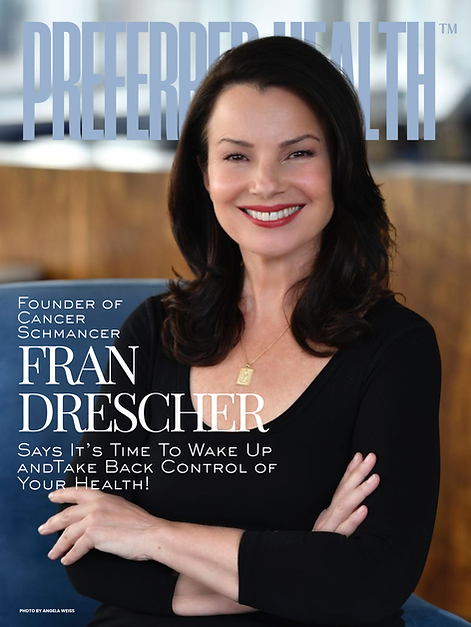
Nearly a decade ago, Fran Drescher graced the cover of Preferred Health Magazine.
Now, she’s back—and the timing couldn’t be more meaningful.
Much has changed since that cover, but Drescher’s commitment to transforming the way we think about health has only grown stronger. What began more than two decades ago with her own deeply personal cancer experience evolved into Cancer Schmancer, a mission centered on prevention, early detection, and health education. Today, her message reaches far beyond cancer, challenging us to look deeper at the systems within the body, examine the role of lifestyle and environment, and become more informed participants in our own healthcare.
From inflammation and nutrition to longevity, functional medicine, and emerging approaches to brain health, Fran sees an awakening taking place in medicine—and she wants patients to be part of it. Her philosophy is simple but powerful: Don’t wait until something goes wrong to start paying attention to your health.
That message will take center stage at the upcoming Master Class Health Summit October 17th, where Fran Drescher is turning the spotlight toward prevention, Alzheimer’s disease, and dementia, bringing together experts to explore new perspectives on brain health and the biological systems that influence it.
As she returns to the pages of Preferred Health Magazine, Fran reflects on the journey that brought her here, the medical system she believes needs to evolve, and why the future of health may depend on all of us becoming more proactive, curious, and empowered.
Preferred Health Magazine: You’ve spent more than two decades transforming a deeply personal cancer experience into a powerful public health mission. What began as your own journey with cancer evolved into Cancer Schmancer’s broader work in prevention, early detection, and health education. Was there a defining moment when you realized your experience could become a catalyst for something much bigger—and that your story could help change the way people approach their health?
Fran Drescher: The cornerstone was women’s gynecologic cancer because that was my cancer. But as the years went on, and I obsessed over causation anyway, I began to realize that inflammation plays an important role in many cancers. And so, it’s almost not necessary to isolate a cancer, but to actually understand all the systems in the body and how to prevent cancer. Obviously, prevention is the best approach, and early detection is critical.
I also started to wonder why everybody is getting diagnosed in the late stages. Where are the breakdowns happening? Because I’m a systems analyst’s daughter, and so I’m always looking at systems and seeing where they may be broken.
That’s what has helped me as president of a labor union. When it came time to negotiate our contract, I could see where new blank pages needed to be written because certain issues simply weren’t being addressed. And in Western medicine,
"I think that we're looking too much at the end symptom, which is,
of course, cancer. But in reality, there’s a long story that was happening before that, and systems in the body that weren't doing their job properly. And that's what we really have to start looking at."
PHM: From longevity medicine and stem-cell research to mitochondrial health and other emerging areas of science, there is an extraordinary amount of innovation happening right now. What makes this moment so compelling for you, and where do you see these advancements taking medicine in the years ahead?
FRAN: It’s an awakening, for sure. I think not to think this way is long overdue. And I’m glad to see that there are certainly doctors who are incorporating more functional medicine into their practices. And I appreciate targeted cancer chemotherapy and looking more at causation—what to eliminate, diet, and all of that. So yes, I’m very pleased.
I hope, in some small way, Cancer Schmancer has contributed to that awakening because you can wait a very long time for a medical system to change its thinking. Or you can activate patients into medical consumers and ignite that paradigm shift much sooner. And I’m working from that end mainly because I think that when patients start taking more control of their bodies, understanding the early whispers, and being more proactive about tests that are available but may not be offered—even on the doctor’s menu—so much can change. With so much going on in the world, I think a lot begins with the consumer. And I like to think of patients as medical consumers.
PHM: Your health summits have expanded into different topics. You have women’s aging, menopause, nutrition, the microbiome, longevity, Alzheimer’s, and more. What do you think that evolution says about the health questions people are asking today?
FRAN: Well, why are we such a sick nation? What the hell is going on? And the hardest part is deprogramming the brainwashing that Americans got through the 20th century by very expensive advertising that made people think that things are good when they’re not. That’s what people have to start really focusing on. What are they bringing into their home that’s systematically breaking down their body’s immune system and creating low-level inflammation that stays in our bodies?
So, we’re not necessarily able to fight a rare virus that becomes a pandemic because so many Americans are already fighting so many other things. We need to become much healthier as a nation. Part of that is looking at your lifestyle because most of it is environmentally stimulated. Even genes have different ways to express themselves. If you have a gene that tests positive for a disease, it does not mean you will get it. But how pristine is your life? How much are you honoring your body? Otherwise, yeah, it’s going to twist in the wrong direction, and you’re going to live to regret it.
PHM: You mentioned earlier how antiquated the medical system is, and how our way of thinking is still stuck in the 20th century. We grew up—and generations before us grew up—believing the doctor is always right. Our primary care doctor knows all and is kind of the end-all, be-all. Doctors have misdiagnosed you, only for you to ultimately receive the correct diagnosis. What advice can you give patients who stick to that first diagnosis and are still trapped in that way of thinking?
FRAN: That’s what we do. We try to motivate, educate, and activate people to stop being mindless and start being mindful about connecting. How you live equals how you feel, and there’s almost no wiggle room in between. It’s a rude awakening, but we shake them up and wake them up because almost everything that we learned—I mean, look what’s happened through the 20th century environmentally—the way we farm is wrong.
The food we eat is mostly toxic. All the processed foods must be eliminated from your diet. It’s all corn syrup, sweeteners, and chemicals. And you are not only what you’re eating; you’re what what you’re eating is eating. And I have no objection to eating animal protein, but that animal better have been raised on a regenerative organic farm in conjunction with growing food, vegetables, and grains. Because when you work with nature instead of against it, or in defiance of it, like arrogant greed mongers have been all these years, you realize how important bovines are to the planet.
Most of what is grown for us to eat—plant-based foods—most of it is inedible. There’s toxins on the plant that we eat. What happens to all that other stuff? The cows eat it, then they defecate, and that becomes nutrient-rich soil. Then you move the cows to another grazing area, and the area they just left is ready to grow again.
PHM: It’s like a vicious cycle when it’s not done organically, and that same process takes
place over and over.
FRAN: When it’s not done organically and you’re not practicing regenerative farming, then you’re basically on a Monsanto farm. And what happens is the nutrient value—if the earth feeding the plant is degraded to the point where we’re eating stuff that doesn’t have value—that also degrades our health because we need to be eating highly nutrient-rich foods. And that’s not going to come from foods that are grown on land that is covered with pesticides and herbicides. It all has to be changed.
But again, the mindful consumer has to look for those regenerative labels: regenerative meat, regenerative eggs, and regeneratively grown fruits and vegetables. We have to start directing how our food is grown through supply and demand, or nothing is going to change. And it’s our lives and our health that are at the expense.
PHM: There’s an enormous amount of health information and misinformation available online. So how can people distinguish between genuinely useful health education, like what you’re providing, and something that sounds scientific and more persuasive because the marketing is just beyond control?
FRAN: Yes, that’s true. That’s why, first of all, the internet is like a black hole of misinformation. Don’t go to social media. You are in a silo when you do that. And now they’ve got you. And now they’re going to use all of their techniques to brainwash you even worse than you’ve already been brainwashed by the 20th century.
So, I would say to find people—leaders in this space—that you feel are trustworthy, like me and Cancer Schmancer, like your magazine, and not get caught up in a world of bots that have greed at the core of what they’re saying.
You’ve got to see when they say, “Well, research shows.” Well, who did the research? Was it the people that are at risk of not making as much money? Who paid for that research? Was it Monsanto? Was it Johnson & Johnson? You know what I mean? You have to use common sense. You don’t even have to read anything. Just stop using chemicals, go into a macro kind of a lifestyle, and make your barometer—keep going organic as much as you can.
PHM: What does your daily health routine look like?
FRAN: Well, I’m very mindful of my environment. That’s our progressive program called Detox Your Home. And I live it, so does Sue, my executive director, and so do the people who follow us. And every day you’re going to be presented with choices. So, it’s something you’re always mindful of in your head. Are you going to buy the plastic bottle or the glass bottle? Are you going to buy it if it’s not organic fruit, but you’re really in the mood for it?
You know, it’s constant choices. And that is my day. I try and, you know, I never cook with aluminum foil. I don’t have a microwave. I got rid of my cordless phones years ago because they emit so much radiation. They’re squeezing us into this Wi-Fi lifestyle, which isn’t good because it’s in direct opposition to our natural energy field. And so, we have to reduce radiation in our lives. I have a cellphone, but I never hold it to my ear. I have it on a stand right now, and it’s on the speaker. So, I try not to touch it all day long, and I try never to hold it to my ear. So, what’s easy is what’s harming us. It’s a little more challenging, but it gets easier.
We were sold this bill of goods that all of these symptoms come with age. And, of course, the only solution is a prescription drug. But lifestyle change is really the way to go. And you have to—and you go deeper and deeper and deeper. And you just keep changing, and you’ll notice you feel better. You don’t get sick as much.
PHM: You’ve built a platform where medicine, nutrition, lifestyle, and emotional well-being
all exist in the same conversation.
FRAN: This harks back to the systems within the body. People say to me, “You have beautiful skin.”
I say, “I have a clean liver.” However, hello, you don’t need to put topical things on your face if you have a zit or something. You need to ask what toxins your skin is trying to rid itself of, you know? That’s another thing that the United States really drove into the zeitgeist of our culture, which is you have to suppress symptoms.
Symptoms are your body’s way of fixing the problem and telling you there’s a problem.
If you have problems with your skin, you have to look at what you’re doing to your body, particularly your liver. If you have headaches, you could take a pain reliever, but you should really say, “Are you dehydrated? Is all you had today coffee?” These are just all the things that you have to think of.
For me, I don’t use sunscreen all the time because we need the sun. But I sit in the shade a lot of the time, or I’ll carry an umbrella, or sometimes I’ll put a very pure, mineral-based sunblock on my face or on the tops of my hands. Some companies sell clothes that help you do that. So, it’s just a new way of resolving a problem.
Even when I sneeze at something. I always have fresh flowers in the house. When they start to wilt, they emit things that suddenly make me sneeze. Now, I could take an antihistamine, but it’s the histamines in my body trying to repel what my body doesn’t like and also get rid of the flowers. It’s connected.
I don’t work in an office. Offices are often very toxic. Industrial manufacturing, industrial carpeting, industrial desks—some offices don’t have windows that open!
So, you know, it’s a lot of reprogramming, retraining, but you do see the results. And it’s very important because you need to honor your body, and you have to trust manufacturers less, you know. And if you boycott things, they’ll hear you because that’s the only language they understand.
PHM: Let’s talk about the upcoming Health Masterclass Summit October 17th.
The focus is dementia and Alzheimer’s.
FRAN: This year, it's all about prevention and reversal of Alzheimer's and other dementias. But the doctors that we're speaking to are not the average doctors. Like, you know, our main neurologist who really wrote the book on the end of Alzheimer's. Dale Bredesen. Very respected guy for the research that he's proved. You know, so I decided, and he works with a group that just deals with you know, like taking all the tests. I'm jumping through all these hoops to become a better interviewer and also get a baseline. So, its stool, saliva, urine, blood, MRI. Then there's a cognitive test with questions, pictures, and things they want to do. And what they're looking for. Now, even the MRI is not the usual MRI that your garden variety neurologist, because your mom doesn't know who you are anymore, is going to give. The demand for this kind of MRI that I took goes through the brain in much thinner slices, looking, looking, looking, but they have to request that. The imaging center won't do it automatically. So, these are the things we're going to learn about.
And make sure people are asking. Do you have Lyme Disease? Do you have mold in you? Do you have heavy metals in you? Do you have high sugar? You know, and the list goes on and on. Look how dementia problems are on the rise. All cognitive problems are on the rise. You know, they say Alzheimer's and autism is basically the same on different ends of the life. I met a woman who came up to me at one of my master classes. She said, "I'm one of the people Dr. Dale Bredesen writes about in his book. I was so far gone, everybody in my life wrote me off already. And I don't remember what person in her life said, 'We're going to meet this guy. He wrote this book.’
She said, ‘I went on his program. I was put on his program, everything. And I could feel the veil lifting off of my brain. And look at me now.’
PHM: We have a philosophy here. Our motto is “Keeping Health Hip,” right? We want to reach younger readers and make sure they’re learning. And we don’t want to talk about sickness like it’s the end-all, be-all. We want to talk about health and prevention. If you could give our readers one piece of advice about becoming more proactive, informed, or empowered about their health, what would that be?
FRAN: Well, I would say it’s not your fault. It’s the brainwashing of greed mongers in the 20th century. But now just listen to your heart wisdom.
The solution to being healthy is making healthier choices. And that’s entirely up to you. Every day you’re going to be presented with choices. It’s going to be your choice to change or succumb to the brainwashing. And what you choose will determine how you feel, how you age, everything. So just start. Don’t be overwhelmed by everything that’s wrong in the world. Tune out. You can’t control that. All you can control is yourself. And then, each one, teach one.
To get tickets for Fran Drescher's upcoming Master Class Health Summit visit:
https://www.cancerschmancer.org/summit-2026/
EDITORIAL DISCLAIMER
The views, opinions, and statements expressed in this interview are those of the interviewee and do not necessarily reflect the views or opinions of Preferred Health Magazine (PHM), its editorial team, or its affiliates. This interview is intended for informational and educational purposes only and is not intended to constitute medical advice, diagnosis, or treatment. Readers should consult with a qualified healthcare professional regarding any medical condition, diagnosis, treatment, medication, dietary change, or health decision. The information presented in this interview should not be used as a substitute for professional medical advice or as a basis for delaying or discontinuing recommended medical care. Individual health circumstances vary, and readers should independently evaluate health information with an appropriately qualified healthcare professional.