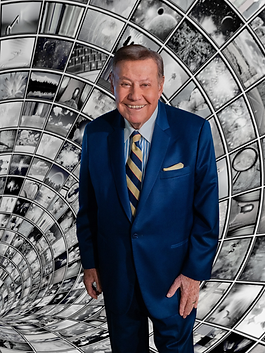
Photography By Vital Agibalow
A Trusted Eyewitness
MARVIN SCOTT
A Legacy Built on Truth, Tenacity, and Tireless Dedication
By Angelina Cappiello
There are journalists who chase headlines, and then there are journalists who become woven into the emotional memory of a generation.
For the past six decades, Marvin Scott has occupied that rare space.
He has reported from war zones and disaster scenes. He has interviewed presidents, grieving
mothers, murder investigators, survivors, international political figures, and ordinary people
whose lives suddenly collided with history. He has covered fires, corruption scandals,
terrorist attacks, international conflict, and some of the most defining moments in modern
American life. And after all of it-after witnessing humanity at both its worst and most extraordinary-he still speaks about journalism with a kind of reverence rarely heard today.
Not cynicism. Not fatigue. Reverence.
Amid the beauty and tranquility of Palm Beach, where sun-drenched avenues
meet the timeless charm of coastal living, I took the opportunity to sit down with Marvin Scott-a
cherished friend, loyal supporter, and contributing writer for Preferred Health Magazine. Joined by
his wife, Lorri, Marvin reflected on his extraordinary journey through decades of journalism,
sharing memories of the historic moments he witnessed and the unforgettable stories that shaped both history and the man behind the microphone.
I opened our conversation with a question that had long lingered in my own mind from my days as a young reporter at the New York Post: How do journalists set aside their personal emotions and objectively report the news when so much of it is rooted in tragedy, conflict, and heartbreak?
“First and foremost, I’m a human being. I have feelings. I also have a responsibility to tell stories,” Marvin said matter-of-factly. That sentence may explain why his career has endured through six decades of shifting technology, political upheaval, terrorism, war, and an evolving media culture.
In an era dominated by opinion panels and performative outrage, Marvin represents an older tradition of journalism—one rooted in objectivity, humanity, and trust.
Marvin has been honored with 15 Emmy Awards, he is a member of the New York Broadcasters Hall of Fame, and a recipient of the Ellis Island Medal of Honor for outstanding Americans. He also holds the “Key to the City,” bestowed to him by former NYC Mayor Eric Adams in December, 2025 and has a photograph that he had taken of John F. Kennedy cataloged at the Library of Congress.
But long before the awards, the legendary status, and the standing ovations, Marvin was simply a young reporter learning how emotionally brutal journalism could be.
He tells me the story about a deadly fire early in his career— one involving children— and realizing that the emotional residue of tragedy does not disappear once the cameras stop rolling.
“Early on, when I would cover a tragic story, it stayed with me for days and for weeks,” Marvin recalled. “I remember covering a fire in my first or second year and the number of children who were lost in the fire. I could not get it out of my mind. And while I had that heartbreak at the moment when I would see something tragic, in the end I still would be able to sit down and write a forthright, objective story.”
That balance between compassion and professionalism became the defining signature of his work. Unlike many modern personalities in media, Marvin never built his career around opinion. He built it around credibility.
"Events create the news…
but it’s the people who make the news."
When asked what concerns him most about the future of journalism, his answer came instantly. “That we never lose sight of our objectivity,” he said. When I mention the erosion of trust in media and the growing dominance of commentary over reporting he said, “Too many people have lost sight of just reporting the facts. Leave the commentary to the commentators. I still believe local news is your best source for news. Just tell it straightforward.”
But even as he speaks about the industry’s future, his greatest passion remains exactly what it has always been: people. “Events create the news… but it’s the people who make the news,” Marvin said. That philosophy has shaped some of the most profound moments of his career.
One of those moments involved a young girl named Stephanie Collado. She was just 12 years old when Marvin first covered her story. Stephanie desperately needed a heart transplant, and the segment aired as both a report and a plea for awareness. “I helped a young girl who needed a heart transplant,” he recalled. “She was 12 years old… I did the story. She wound up getting the heart, and I believe we were partially responsible because of the story I had on the air.”
Unlike many reporters who move on to the next assignment, Scott stayed connected with Stephanie and her family for years. “We stayed in touch,” he said with a smile. “I would call her on her birthday each year.”
Then came a devastating call. “Her sister said, ‘Stephanie’s not doing well… her heart is failing,’” Marvin remembered. “I spoke to her [Stephanie] on a Friday night… Through her pain I could hear the smile in her voice when she heard I was coming to visit to do another helpful story the following week. The next morning, I got a call from her mother. "She passed overnight,” he said quietly. Scott pauses when he recounts the story, even now. “I delivered the eulogy at her funeral and was one of her pallbearers.”
The line lands with enormous emotional weight—not because it is dramatic, but because it is deeply sincere. It also reveals something essential about Marvin Scott: he never views journalism as transactional. For him, storytelling has always carried responsibility. And sometimes, extraordinary impact.
In 2017, Marvin published his memoir, As I Saw It: A Reporters Intrepid Journey, in which he recalls news assignments that impacted his life and the world. With the book’s foreword written by his dear friend and legendary reporter Dan Rather, and a Table of Contents that resembles a historical timeline —with experiences ranging from a meeting with Marilyn Monroe, covering the march for civil rights with Dr. Martin Luther King Jr., to the U.S. space program — Marvin recalls events like a fountain overflowing.
One life-changing story involved a man desperately searching for a kidney donor.
A story that initially came via his wife, Lorri. “My wife found his appeal on Facebook,” Marvin said giving a nod to Lorri who sat across from her husband of 20 years. “She said, my husband’s a television reporter—maybe he could do a story about your plight.”
The segment aired. Viewers responded. “It was Christmas time,” Marvin recalled.
“‘All I want for Christmas is a new kidney.’ Twelve people responded—none was a match. But the thirteenth was a match!” he said. Months later, Brett Ashley received his transplant. In a follow-up interview, Marvin recallled, “He looked me in the eye and said, ‘Marvin, you saved a life.’”
With humility Marvin stated, “I feel blessed to be in a position where I can not only tell stories, but I can influence change.”
That influence extended beyond human-interest stories into investigative reporting as well.
In one major investigation, Marvin uncovered widespread cheating involving standardized reading exams in New York schools. Students had allegedly been given test answers in advance in order to improve school funding outcomes.
“I found out children in one school in Brooklyn were provided with a test in advance that had the actual answers,” Marvin said with dread. The investigation spread statewide. “I reached out to a number of people and found that it was happening in other places.”
The report eventually led to legislative hearings in Albany and the passage of laws criminalizing the practice. “That was a moment,” he said proudly. "Then New York Governor Hugh L. Carey gave him the pen to sign the bill. "That was how it affected change.”
Few journalists ever become eyewitnesses to world history at the level Marvin has experienced. His reporting has taken him across conflict zones and disaster areas throughout the world. “I’ve traveled the world. I’ve been to Phnom Penh, Cambodia. Beirut. Iraq. Afghanistan.”
Yet when discussing those experiences, Marvin rarely centers himself. Instead, he remembers the civilians. The mothers. The children. The human cost.
“Seeing a casket of a soldier going home from Iraq, or a mother and her children clinging to whatever food they could get along a desolate road in Cambodia… you recognize the value of life,” he said. “You respect your life much more and appreciate it and value it. Because you see how easily it can be taken.”
No event shaped him emotionally more than September 11th. “9/11 was probably the worst I ever had to cover,” Marvin said. He recalls interviewing a woman on air who remained convinced her husband would survive the attacks. “She told us he was on the top floor… and we knew that it was not possible for anyone to have survived from that height.”
For one brief moment, the veteran reporter became visibly emotional on air. “I just got emotional. A tear dropped from my eye,” Marvin admitted. “I was not embarrassed,” he said. “I was a human being, and I was responding with an emotion that was real.”
Among the most intriguing interviews of his career was a conversation with Abraham Zapruder, the man who filmed the assassination of President John F. Kennedy in real time.
According to the Sixth Floor Museum in Dallas, Zapruder rarely granted interviews. Marvin changed that through connection—not pressure. “Mr. Scott, thank you very much. I don’t do interviews,” Zapruder initially told him. Marvin pivoted away from journalism and toward shared roots. “I knew he came from a Russian Jewish family in Brooklyn… I changed the conversation,” he recalled. The conversation shifted naturally into memories of New York.
"I told him I was from the Bronx. That connection did it," Marvin recalls. “Oh, Bronx boy,” Zapruder responded warmly. Eventually, Zapruder invited him to meet at Dealey Plaza. “We stood at the grassy knoll, and his eyewitness account about that awful moment in history convinced me there was a single shooter, " he explained.
For all his professional accomplishments, Marvin remains remarkably grounded away from the cameras. When asked who Marvin Scott is when the lights turn off, his answer feels refreshingly simple. “Marvin Scott is someone who enjoys life,” he said.
"I love going to Yankee games with my grandchildren, traveling with my wife, and enjoying dinners with friends. Particularly enjoy challenging conversations on matters I'd never discuss on air."
Even now, Marvin continues to work as Senior Correspondent for WPIX-TV, often producing full television packages from editorial meeting to live broadcast within hours. What keeps him going? Well, he simply states, “I enjoy what I’m doing. I’m not trying to prove anything to anyone.
I simply enjoy what I do.”
Asked how he stays so focused and sharp all of these years, Marvin shares, “The brain is like a muscle, and you have to keep it active.”
That passion now extends beyond television journalism. Marvin continues promoting his acclaimed memoir while developing a feature film based on one of the book’s most unforgettable chapters: Charlie’s Odyssey. The true story of Charlie Walsh, a modest New Jersey man who accidentally discovered more than $100,000 had appeared in his bank account and slowly withdrew the money over time.
Marvin is also pursuing another longtime dream: a photography book featuring decades of images captured throughout his extraordinary career. There is something beautifully fitting about that.
Because after sixty years of documenting history through words, Marvin Scott is still searching for new ways to frame the human experience.
And perhaps that is his true legacy.
Not simply that he witnessed history.
But that he never stopped seeing the
people living through it.
As Dan Rather eloquently writes in the foreword to Marvin Scott's book: "The dictionary defines intrepid as 'possessing resolute fearlessness, fortitude, and endurance.' That is precisely the right word to describe Marvin Scott's extraordinary journey as a lifelong reporter—and the man himself. It fits Marvin like a bespoke suit."